Benario
Sodium Acetate Anhydrous FCC VIII — E262 Food Buffer & Preservative
Sodium Acetate Anhydrous FCC VIII — E262 Food Buffer & Preservative
Couldn't load pickup availability
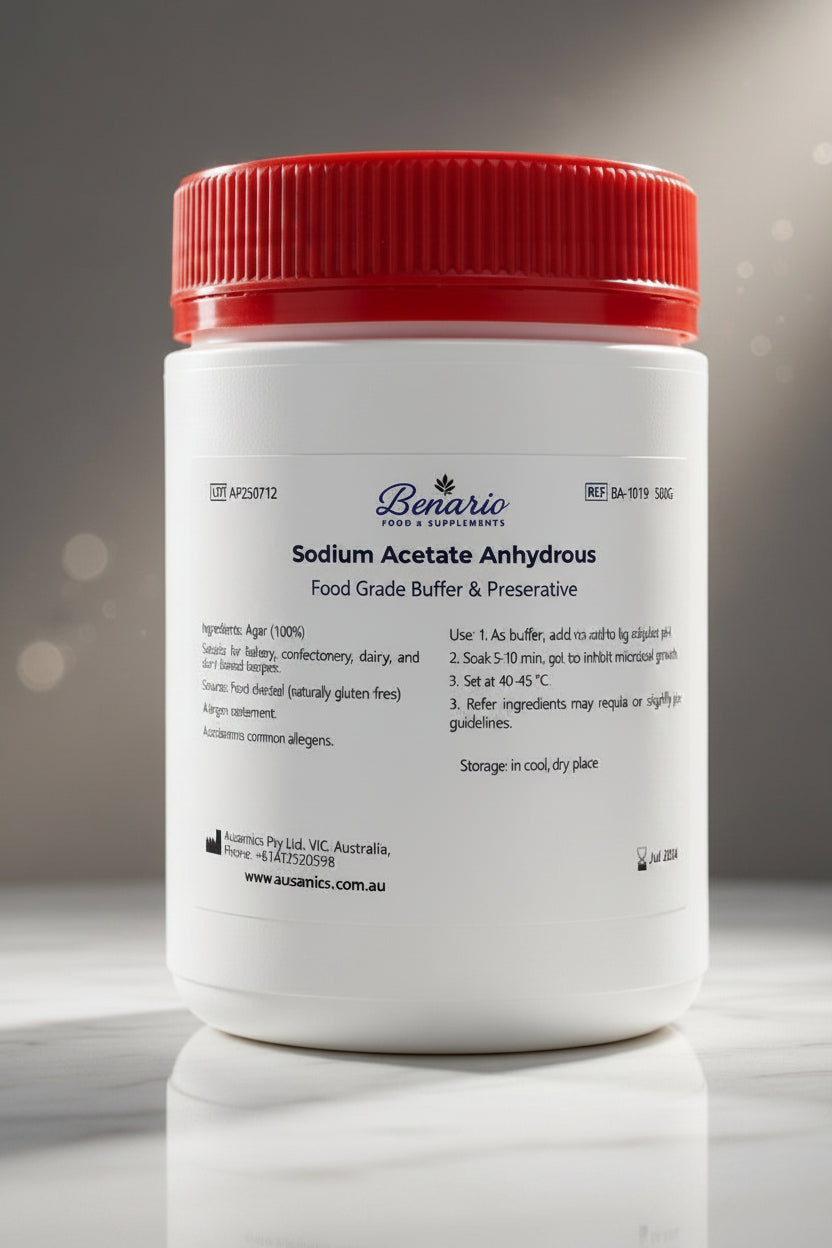
Benario Sodium Acetate Anhydrous FCC VIII is a food-grade sodium acetate powder used as an acidity regulator, pH buffer, preservative-support ingredient and seasoning-system component. It is commonly used in sauces, dressings, pickles, savoury snacks, vinegar-style seasonings, processed foods, beverage systems, R&D formulations and food manufacturing where controlled acetate buffering and sodium acetate functionality are required.
- FCC VIII food-grade sodium acetate — suitable for food additive formulation use
- E262 / INS 262(i) — recognised sodium acetate food additive number
- Anhydrous form — higher active sodium acetate content than trihydrate form
- Useful as acidity regulator, pH buffer and preservative-support ingredient
- Pairs with acetic acid/vinegar systems to help maintain target pH
- White crystalline powder or granules — easy to weigh and blend
- Four practical pack sizes: 500g, 1kg, 2.5kg and 5kg
| Property | Detail |
|---|---|
| Also known as | Sodium acetate, sodium ethanoate, sodium acetate anhydrous, NaOAc |
| CAS number | 127-09-3 |
| Food additive number | E262 / INS 262(i) |
| Grade | FCC VIII |
| Formula | C₂H₃NaO₂ / CH₃COONa |
| Form | White crystalline powder or granules |
| Function | Acidity regulator, pH buffer, preservative support, seasoning ingredient |
| Solubility | Highly soluble in water |
| Moisture behaviour | Hygroscopic / moisture-sensitive — keep sealed |
| Sodium contribution | Contains sodium — account for nutrition panel and sodium claims |
| Pack sizes | 500g · 1kg · 2.5kg · 5kg |
| Storage | Cool, dry, sealed; protect from moisture |
Benario is a trading name/food ingredient brand backed by AuSaMicS Pty Ltd (ABN 56 676 640 467). This product is supplied as a food ingredient/additive for formulation use. Final usage level, food additive permission, pH target, preservative validation, nutrition panel, sodium declaration and label compliance are the buyer’s responsibility.
Sodium Acetate Anhydrous is used where acetate buffering, pH control, savoury acidity balance or preservative-support functionality is required. It is usually formulated with acids such as acetic acid/vinegar systems, and performance depends on pH, water activity, salt level, processing method, packaging and the full preservation system.
| Application | Typical use approach | Notes |
|---|---|---|
| Sauces / condiments | Formula-specific pH adjustment | Use with acid system and verify finished pH |
| Pickles / acidic foods | Buffering and acidity control | Check taste, sodium level and preservation targets |
| Snack seasonings | Dry blend ingredient | Supports vinegar/savoury profile in seasoning blends |
| Meat / prepared foods | As permitted by formula and regulations | Validate shelf-life and label declaration |
| Beverage / liquid systems | Dissolve before final blending | Check flavour, sodium contribution and pH |
| Food R&D | Small pilot trials | Useful for acetate buffer and pH-control testing |
| Ingredient | Main role | Key difference |
|---|---|---|
| Sodium Acetate Anhydrous | pH buffer / acidity regulator | Anhydrous sodium acetate; high active content; moisture-sensitive |
| Sodium Acetate Trihydrate | pH buffer / acetate source | Contains water of crystallisation; lower active content per gram |
| Sodium Diacetate | Acidic acetate / seasoning / preservative | More vinegar-like acidity and flavour impact |
| Acetic Acid / Vinegar | Acidulant | Provides acidity; often paired with acetate salts for buffering |
| Potassium Acetate | Acetate salt / pH control | Potassium salt option where sodium reduction is needed |
- Dissolve in water before adding to liquid products where uniform distribution is required
- For dry seasonings, pre-blend thoroughly with carriers, salt, acids and flavours
- Measure pH after full hydration and mixing, not immediately after dry addition
- Account for sodium contribution in nutrition information and front-of-pack claims
- Use clean, dry utensils — moisture can cause clumping and reduced flow
- For preservation use, validate with finished-product shelf-life and microbial testing
- Store tightly sealed in a cool, dry place
- Protect from humidity and moisture to prevent clumping
- Use clean, dry utensils only
- Close container immediately after weighing
- Keep away from strong acids, strong oxidising agents and incompatible materials
Usage levels are formula-specific and depend on product type, pH target, sodium limit, food additive permissions and preservation system. Always run pilot trials and confirm finished-product compliance before commercial sale.
| Parameter | Specification / typical detail |
|---|---|
| Product name | Sodium Acetate Anhydrous FCC VIII |
| Chemical name | Sodium ethanoate |
| CAS number | 127-09-3 |
| Food additive number | E262 / INS 262(i) |
| Grade | FCC VIII |
| Molecular formula | C₂H₃NaO₂ / CH₃COONa |
| Molecular weight | 82.03 g/mol |
| Appearance | White crystalline powder or granules |
| Odour | Odourless to slight acetic/vinegar note |
| Solubility | Highly soluble in water |
| Moisture behaviour | Hygroscopic / deliquescent — protect from air and moisture |
| Assay | Batch-specific — see COA |
| pH | Batch-specific — see COA |
| Loss on drying | Batch-specific — see COA |
| Heavy metals | Batch-specific — see COA |
| Microbiology | Batch-specific — see COA if applicable |
| Size | Best for |
|---|---|
| 500g | R&D, small-batch trials, seasoning tests and pilot formulations |
| 1kg | Regular food formulation, sauce trials and small production |
| 2.5kg | Small food businesses, repeated batching and commercial testing |
| 5kg | Food manufacturers, seasoning producers and frequent users |
| Use case | Possible declaration style | Note |
|---|---|---|
| As acidity regulator | Acidity regulator (262) or Acidity regulator (Sodium acetate) | Check local ingredient-labelling rules |
| As preservative function | Preservative (262) or Preservative (Sodium acetate) | Use only where permitted and technically justified |
| As ingredient name | Sodium acetate | May suit food manufacturing ingredient lists |
| Sodium declaration | Include in nutrition calculation | Required for accurate sodium panel values |
COA available on request — support@ausamics.com
Specifications represent typical information for Sodium Acetate Anhydrous FCC VIII. Batch-specific values, assay, purity, pH, heavy metals and compliance documents must be confirmed by Certificate of Analysis and supplier documentation.
Sodium Acetate Anhydrous FCC VIII is a food-grade powder with low hazard under normal ingredient handling. The main safety considerations are dust control, eye irritation, moisture protection, sodium contribution and correct use within validated food formulations.
- Food-grade FCC VIII ingredient for formulation and manufacturing use
- Not supplied as a finished food, supplement or therapeutic product
- Avoid inhaling dust during weighing, blending or filling
- May cause mild eye, skin or respiratory irritation as a dry powder
- Contains sodium — account for nutrition panels and sodium-sensitive applications
- Keep sealed and dry to maintain powder flow and reduce clumping
- Request batch SDS and COA for commercial use
| Route | Action |
|---|---|
| Skin contact | Wash with soap and water. Seek medical advice if irritation persists. |
| Eye contact | Rinse carefully with clean water for at least 15 minutes. Seek medical advice if irritation persists. |
| Inhalation | Move to fresh air. Avoid further dust exposure. Seek medical advice if coughing or irritation persists. |
| Ingestion | Food ingredient when used appropriately. If large quantities are consumed or symptoms occur, seek medical advice. |
| Hazard category | Classification / note |
|---|---|
| Physical hazards | Not classified under normal dry-powder handling conditions |
| Health hazards | Dust may cause mechanical irritation; refer to SDS |
| Environmental hazards | Not expected to be classified at typical ingredient quantities |
| Signal word | Refer to batch SDS |
- Use in a clean, dry, well-ventilated area
- Avoid creating airborne dust
- Wear gloves and eye protection for commercial handling
- Keep container tightly closed when not in use
- Clean spills using dry methods where possible; avoid raising dust
- Keep away from strong acids and strong oxidising agents
Full SDS available on request — support@ausamics.com
This is a general safety summary only. For commercial use, request the full SDS. AuSaMicS Pty Ltd accepts no liability for misuse, unsuitable formulation, unsupported preservative claims, inaccurate sodium calculations or non-compliant labelling by the buyer.
Have a question not answered here? Contact us at support@ausamics.com — we typically respond within 1 business day.
Share