Benario
Potassium Citrate Monohydrate (Food Grade) — Buffer, Emulsifier & Mineral Salt
Potassium Citrate Monohydrate (Food Grade) — Buffer, Emulsifier & Mineral Salt
Couldn't load pickup availability
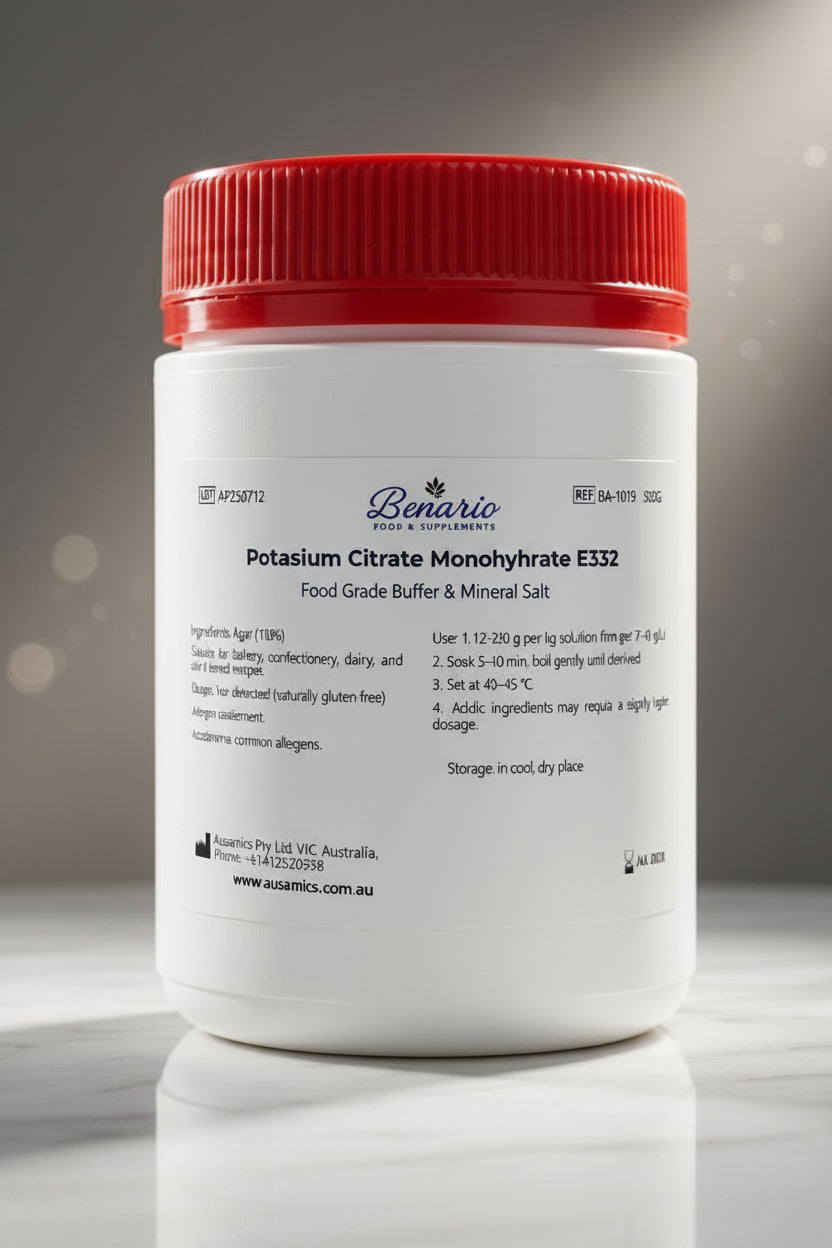
Potassium Citrate Monohydrate (E332) is a versatile food-grade potassium salt of citric acid — used as a buffering agent, emulsifier, sequestrant, acidity regulator and mineral source. Approved under FSANZ Standard 1.3.1, it is widely used in sports drinks and electrolyte formulas as a bioavailable potassium source, in processed cheese as an emulsifying salt, in jams and confectionery for pH control, and in food manufacturing for its excellent buffering capacity at near-neutral pH.
- FSANZ Standard 1.3.1 approved (E332) — legal for use in Australian food products
- ≥99.0% purity — lab-tested, Certificate of Analysis available on request
- Excellent potassium source — 38.3% potassium content by weight (highly bioavailable)
- Buffering capacity at pH 5.5–8.5 — ideal for near-neutral food and beverage applications
- Packed in Australia — quality-checked before every dispatch
- Three sizes: 200g, 500g and 1kg
- Freely water soluble — easy to incorporate into liquid and dry formulations
| Property | Detail |
|---|---|
| E number | E332(iii) — Tripotassium citrate |
| Also known as | Tripotassium citrate monohydrate, potassium citrate, E332(iii), INS 332(iii) |
| Chemical formula | C₆H₅K₃O₇·H₂O |
| Form | White crystalline powder or granules |
| Purity | ≥ 99.0% |
| Potassium content | ~38.3% by weight (~383mg K per gram) |
| pH (1% solution) | ~8.0 – 9.0 (alkaline) |
| Solubility | Freely soluble in water |
| Pack sizes | 200g · 500g · 1kg |
| Shelf life | 24 months (sealed, cool & dry) |
| Standard | FSANZ E332, EU E332(iii), FCC, GRAS |
Benario is a trading name of AuSaMicS Pty Ltd (ABN 56 676 640 467). This product is intended for use as a food ingredient in accordance with FSANZ Standard 1.3.1. Always use within permitted levels for the relevant food category. This product is not a therapeutic good.
Potassium Citrate Monohydrate is most widely used in electrolyte drinks and processed cheese — two very different applications that both benefit from its combination of buffering capacity, mineral content and excellent solubility.
| Application | Usage level | Notes |
|---|---|---|
| Sports / electrolyte drink | 0.1 – 0.5% | Potassium source; mild alkaline buffer — dissolve in water |
| Processed cheese / cheese sauce | 1 – 3% | Emulsifying salt alongside sodium citrate |
| Jams & preserves | 0.1 – 0.3% | pH buffering and pectin activation |
| Beverages / pH regulation | 0.05 – 0.3% | Adjust acidity; neutralises citric acid sharpness |
| Confectionery / hard candy | 0.1 – 0.5% | Sequestrant and pH control |
| Fermentation media | 0.1 – 0.5% | Potassium and citrate source for culture media |
| Antioxidant synergist | 0.01 – 0.1% | Chelates metals; enhances antioxidant effectiveness |
| General pH buffering | As per formulation | Target pH 5.5–8.5; verify with calibrated meter |
| Ingredient | K content | Taste | Best for |
|---|---|---|---|
| Potassium Citrate (E332) | ~38.3% | Mild, pleasant | Sports drinks, cheese, food |
| Potassium Chloride (E508) | ~52.4% | Bitter, metallic | Salt substitute (masked) |
| Potassium Bicarbonate (E501) | ~39.1% | Slightly salty | Leavening, pH adjustment |
| Potassium Phosphate (E340i) | ~28.7% | Mild | Buffering, mineral source |
- Dissolve in warm water (40–60°C) with stirring for fastest dissolution
- Fully water soluble — solutions should be clear
- Verify pH after dissolution with a calibrated pH meter
- For pH neutralisation of citric acid, add Potassium Citrate gradually until target pH is reached
- Prepared solutions are stable for up to 2 weeks refrigerated in sealed containers
- Slightly hygroscopic — keep container sealed to prevent caking
- Store in a cool, dry place away from direct sunlight and moisture
- Keep container tightly sealed — slightly hygroscopic
- Shelf life: 24 months from manufacture date when stored correctly
- Keep away from strong acids and oxidising agents
Usage levels are indicative. Always comply with FSANZ Standard 1.3.1 permitted levels. AuSaMicS Pty Ltd accepts no responsibility for use outside recommended guidelines.
| Parameter | Specification |
|---|---|
| Chemical name | Tripotassium 2-hydroxypropane-1,2,3-tricarboxylate monohydrate |
| Chemical formula | C₆H₅K₃O₇·H₂O |
| CAS number | 6100-05-6 |
| E number | E332(iii) |
| INS number | INS 332(iii) |
| Molecular weight | 324.41 g/mol |
| Potassium content | ~38.3% (w/w) |
| Appearance | White crystalline powder or granules |
| Assay (purity) | ≥ 99.0% (on dried basis) |
| Water content | 5.0 – 7.0% (as monohydrate) |
| pH (1% solution) | 8.0 – 9.0 |
| Insoluble matter | ≤ 0.05% |
| Fluoride | ≤ 10 mg/kg |
| Heavy metals (as Pb) | ≤ 5 mg/kg |
| Arsenic | ≤ 1 mg/kg |
| Lead | ≤ 0.5 mg/kg |
| Applicable standard | FSANZ Standard 1.3.1 (E332), FCC 12th Ed., EU E332(iii), JECFA |
| Market | Code / Name | Status |
|---|---|---|
| Australia / NZ (FSANZ) | E332 — Potassium citrates | Approved |
| European Union | E332(iii) — Tripotassium citrate | Approved |
| United States (FDA) | GRAS — Generally Recognised as Safe | Approved |
| INS (Codex) | INS 332(iii) | Approved |
| FCC Grade | Meets Food Chemicals Codex specifications | Confirmed |
| Size | Price (AUD) | Best for |
|---|---|---|
| 200g | $16.90 | R&D, home use, testing |
| 500g | $29.90 | Small commercial, regular use |
| 1kg | $49.90 | Commercial production, food manufacturers |
COA available on request — support@ausamics.com
Specifications represent typical values. Batch-specific results confirmed in COA.
Potassium Citrate Monohydrate (E332) has an excellent safety profile. Approved under FSANZ Standard 1.3.1. Produces an alkaline solution — handle with standard precautions for alkaline salts.
- Approved food additive — FSANZ E332, EU E332(iii), GRAS (USA), FCC compliant
- No known common allergens — gluten-free, vegan and vegetarian suitable
- Alkaline in solution (~pH 8–9) — avoid prolonged eye contact with concentrated solutions
- Contains potassium — people on potassium-restricted diets should consult a healthcare professional
- This product is a food-grade ingredient, not a therapeutic good
- Store away from strong acids — incompatible with concentrated acids
| Route | Action |
|---|---|
| Skin contact | Wash with soap and water. No significant risk at food-grade handling quantities. |
| Eye contact | Rinse with clean water for 15 minutes. Seek medical advice if irritation persists. |
| Ingestion | Food-grade ingredient — no significant risk at normal quantities. Seek medical advice if large quantities ingested. |
| Inhalation | Move to fresh air. Seek medical advice if symptoms persist. |
| Hazard category | Classification |
|---|---|
| Physical hazards | Not classified |
| Health hazards | Not classified at food-grade handling quantities |
| Environmental hazards | Not classified |
| Signal word | None required |
Full SDS available on request — support@ausamics.com
This is a general safety summary only. For commercial use, request the full SDS. AuSaMicS Pty Ltd (ABN 56 676 640 467) accepts no liability for misuse of this product.
Have a question not answered here? Contact us at support@ausamics.com — we typically respond within 1 business day.
Share