Benario
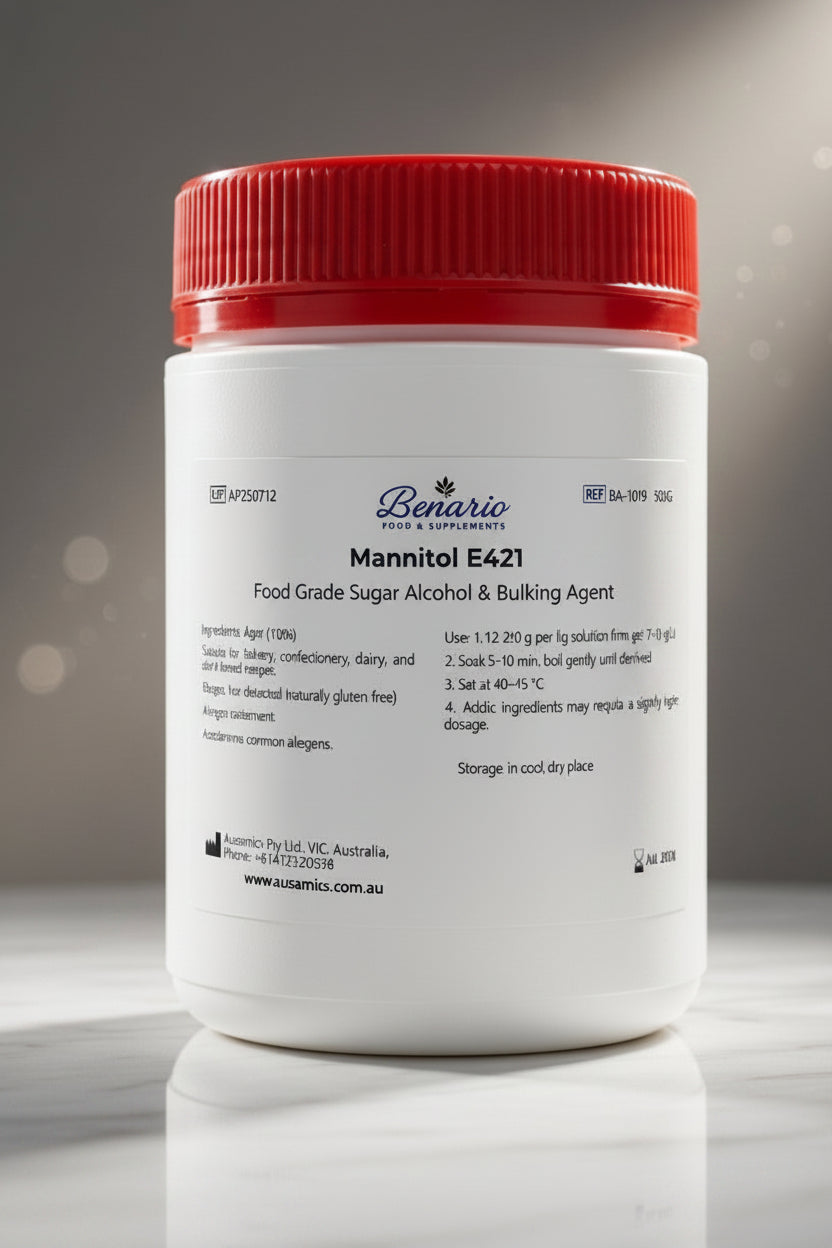
Mannitol Powder (Food Grade) — Sugar Alcohol Bulking Agent & Sweetener
Mannitol Powder (Food Grade) — Sugar Alcohol Bulking Agent & Sweetener
Couldn't load pickup availability
Mannitol (E421) is a naturally occurring sugar alcohol found in mushrooms, seaweed and many fruits — used in food manufacturing as a bulking agent, sweetener, anti-caking agent and texturiser. Approximately 60% as sweet as sucrose with a pleasant cooling sensation on the tongue and very low hygroscopicity — making it the preferred dusting and anti-sticking agent for confectionery, chewing gum and sugar-free products. Pure food-grade powder with ≥98.0% purity.
- FSANZ Standard 1.3.1 approved (E421) — legal for use in Australian food products
- ≥98.0% purity — lab-tested, Certificate of Analysis available on request
- Very low hygroscopicity — does not absorb moisture; ideal for dusting and dry applications
- Pleasant cooling sensation — unique mouthfeel property not found in other sugar alcohols
- Low glycaemic index — minimal impact on blood glucose vs sucrose
- Packed in Australia — quality-checked before every dispatch
- Four sizes: 100g, 250g, 500g and 1kg
| Property | Detail |
|---|---|
| E number | E421 |
| Also known as | D-Mannitol, mannite, manna sugar, E421, INS 421, hexanehexol |
| Type | Sugar alcohol (polyol) |
| Form | White crystalline powder |
| Purity | ≥ 98.0% |
| Sweetness vs sucrose | ~60% |
| Glycaemic index | 0 (GI = 0) |
| Hygroscopicity | Very low — non-hygroscopic |
| Cooling effect | Yes — positive heat of solution |
| Pack sizes | 100g · 250g · 500g · 1kg |
| Shelf life | 24 months (sealed, cool & dry) |
| Standard | FSANZ E421, EU E421, FCC, GRAS |
Benario is a trading name of AuSaMicS Pty Ltd (ABN 56 676 640 467). This product is intended for use as a food ingredient in accordance with FSANZ Standard 1.3.1. Always use within permitted levels for the relevant food category. This product is not a therapeutic good.
Mannitol's defining advantage is its very low hygroscopicity — it does not absorb moisture from the air. This single property makes it irreplaceable as a confectionery dusting and anti-sticking agent, particularly in humid Australian conditions.
| Application | Usage level | Notes |
|---|---|---|
| Confectionery dusting / anti-stick | 1 – 5% | Dust onto gummies, lollies, marshmallows to prevent sticking |
| Sugar-free / reduced sugar sweets | 20 – 60% | Bulking agent — replace sucrose partially or fully |
| Chewing gum base | 20 – 50% | Standard inclusion in sugar-free gum formulas |
| Tablet excipient / powder blend | 10 – 50% | Excellent flow properties; dissolves cleanly |
| Chocolate dusting / anti-bloom | 0.5 – 2% | Dust surface to prevent fat bloom and sticking |
| Sugar-free baked goods | 10 – 30% | Combine with erythritol or xylitol for sweetness balance |
| Cooling confectionery | 5 – 20% | Delivers cooling sensation on dissolution |
| Anti-caking in dry blends | 1 – 5% | Keeps powder blends free-flowing |
| Polyol | Sweetness vs sucrose | Hygroscopicity | GI | Cooling effect |
|---|---|---|---|---|
| Mannitol (E421) | ~60% | Very low ✓ | 0 | Strong ✓ |
| Erythritol (E968) | ~70% | Low | 0 | Strong |
| Xylitol (E967) | ~100% | Low–Medium | 7 | Moderate |
| Sorbitol (E420) | ~60% | High ✗ | 9 | Mild |
| Maltitol (E965) | ~90% | Medium | 35 | Mild |
- Use as a dusting agent by tumbling confectionery in Mannitol powder — prevents sticking without making surfaces wet
- For sweetness in sugar-free products, blend with Erythritol or Xylitol to reach target sweetness level
- Dissolves in water — can be used in liquid applications though hygroscopic stability is its key advantage in dry use
- Does not caramelise or brown under heat — suitable for applications where Maillard browning must be avoided
- Stable under normal food processing temperatures
- Store in a cool, dry place away from direct sunlight
- Mannitol is non-hygroscopic — less sensitive to moisture than most polyols, but keep sealed
- Shelf life: 24 months from manufacture date when stored correctly
Usage levels are indicative. Always comply with FSANZ Standard 1.3.1. Check labelling requirements for polyol content in finished products. AuSaMicS Pty Ltd accepts no responsibility for use outside recommended guidelines.
| Parameter | Specification |
|---|---|
| Chemical name | D-Mannitol (1,2,3,4,5,6-hexanehexol) |
| CAS number | 69-65-8 |
| E number | E421 |
| INS number | INS 421 |
| Molecular formula | C₆H₁₄O₆ |
| Molecular weight | 182.17 g/mol |
| Appearance | White crystalline powder |
| Assay (purity) | ≥ 98.0% (on dried basis) |
| Specific rotation [α]D²⁰ | +137° to +145° |
| Melting point | 165 – 170°C |
| Water content | ≤ 0.5% |
| Reducing sugars | ≤ 0.3% |
| Nickel | ≤ 1 mg/kg |
| Heavy metals (as Pb) | ≤ 5 mg/kg |
| Arsenic | ≤ 1 mg/kg |
| Lead | ≤ 0.5 mg/kg |
| Applicable standard | FSANZ Standard 1.3.1 (E421), FCC 12th Ed., EU E421, JECFA |
| Market | Code / Name | Status |
|---|---|---|
| Australia / NZ (FSANZ) | E421 — Mannitol | Approved |
| European Union | E421 — Mannitol | Approved |
| United States (FDA) | GRAS — Generally Recognised as Safe | Approved |
| INS (Codex) | INS 421 | Approved |
| Diabetic suitability | Low glycaemic index — minimal blood glucose impact | — |
| Size | Price (AUD) | Best for |
|---|---|---|
| 100g | $14.90 | Home confectioners, testing |
| 250g | $24.90 | Regular home & recipe development |
| 500g | $39.90 | Small commercial, frequent use |
| 1kg | $64.90 | Commercial production, bulk buyers |
COA available on request — support@ausamics.com
Specifications represent typical values. Batch-specific results confirmed in COA.
Mannitol (E421) is a naturally occurring sugar alcohol with an excellent safety profile. Approved under FSANZ Standard 1.3.1. Note the laxative effect warning requirement for finished consumer products.
- Approved food additive — FSANZ E421, EU E421, GRAS (USA), FCC compliant
- Naturally occurring in mushrooms, seaweed and many fruits
- Gluten-free, vegan and vegetarian suitable
- Excessive consumption may have a laxative effect — typical threshold 10–20g/day
- Labelling requirement: products may require "excess consumption may have a laxative effect" statement under FSANZ
- This product is a food-grade ingredient, not a therapeutic good
| Route | Action |
|---|---|
| Skin contact | Wash with water. No significant risk. |
| Eye contact | Rinse with clean water for 15 minutes. Seek medical advice if irritation persists. |
| Ingestion | Food-grade ingredient — no significant risk at normal handling quantities. Large quantities may cause gastrointestinal discomfort. |
| Inhalation | Move to fresh air. Seek medical advice if symptoms persist. |
| Hazard category | Classification |
|---|---|
| Physical hazards | Not classified |
| Health hazards | Not classified |
| Environmental hazards | Not classified |
| Signal word | None required |
Full SDS available on request — support@ausamics.com
This is a general safety summary only. For commercial use, request the full SDS. AuSaMicS Pty Ltd (ABN 56 676 640 467) accepts no liability for misuse of this product.
Have a question not answered here? Contact us at support@ausamics.com — we typically respond within 1 business day.
Share