Benario
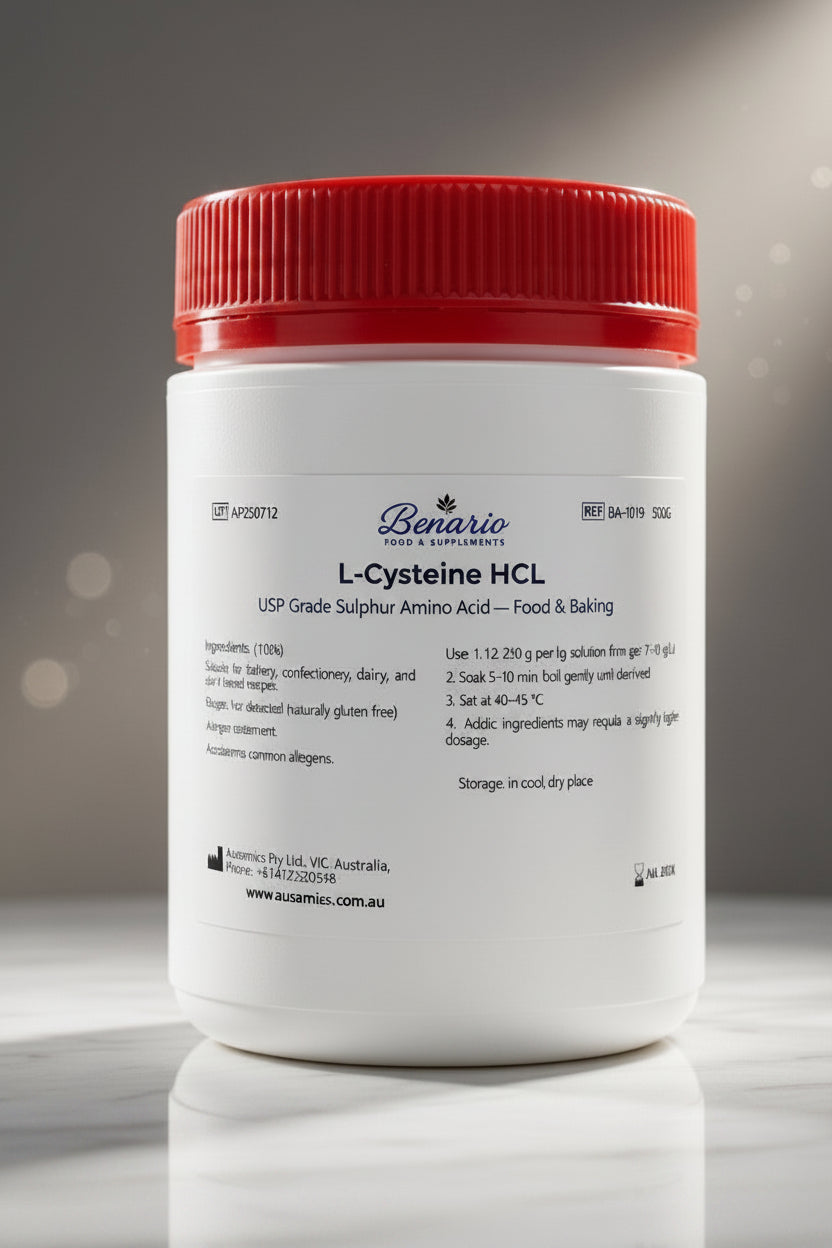
L-Cysteine Hydrochloride USP — Amino Acid for Food & Baking
L-Cysteine Hydrochloride USP — Amino Acid for Food & Baking
Couldn't load pickup availability
Benario L-Cysteine Hydrochloride USP is a high-purity amino acid ingredient supplied as a white to off-white crystalline powder. In food and bakery applications, L-Cysteine is known as E920 / INS 920 and is used as a flour treatment agent to help relax dough, improve machinability and reduce mixing time in selected formulations. It is also used in food, flavour, nutrition and technical formulation work where a USP-grade L-cysteine hydrochloride ingredient is required.
- USP-grade L-Cysteine Hydrochloride — high-purity amino acid specification
- Recognised food additive function — E920 / INS 920 flour treatment agent
- Useful in bakery R&D for dough relaxation, machinability and processing trials
- Water-soluble crystalline powder — easy to dose in controlled premixes
- Strong functional effect at low levels — suitable for precision formulation
- Batch COA available — confirm assay, CAS/hydrate form and source details
- Four practical pack sizes: 100g, 250g, 500g and 1kg
| Property | Detail |
|---|---|
| Also known as | L-Cysteine HCl, L-Cysteine hydrochloride, E920, INS 920 |
| CAS number | 52-89-1 / 7048-04-6 depending on hydrate form — confirm by COA |
| Grade | USP |
| Function | Amino acid ingredient; flour treatment agent; dough reducing agent |
| Form | White to off-white crystalline powder |
| Odour | Characteristic sulfur / amino acid odour |
| Solubility | Soluble in water |
| Application area | Bakery, flour treatment, noodles, food R&D, flavour/nutrition formulation |
| Pack sizes | 100g · 250g · 500g · 1kg |
| Storage | Cool, dry, sealed; protect from air, heat and moisture |
Benario is a trading name/food ingredient brand backed by AuSaMicS Pty Ltd (ABN 56 676 640 467). This product is supplied as an ingredient for food, bakery and formulation use. It is not supplied as a finished dietary supplement or therapeutic good. Final formulation, additive permissions, dosage, source declarations, claims and label compliance are the buyer’s responsibility.
L-Cysteine Hydrochloride is normally used at very low levels in bakery and flour-treatment systems. Its effect is strong, so accurate weighing, premixing and controlled trials are important before commercial use.
| Application | Typical use approach | Notes |
|---|---|---|
| Bread dough | Very low ppm-level use | Used to relax dough and improve machinability |
| Pizza / flatbread dough | Pilot trial required | May reduce snap-back and improve sheeting |
| Noodle dough | Controlled formulation testing | Can influence dough handling and texture |
| Flour premixes | Pre-blend thoroughly | Ensure uniform distribution through carrier system |
| Food R&D | Small controlled batches | Check effect on processing, flavour and shelf stability |
| Flavour systems | Formula-specific | Sulfur amino acid chemistry may affect aroma profile |
- Acts as a reducing agent in dough systems
- Helps relax gluten structure in suitable bakery formulations
- Can reduce mixing time and improve machinability
- May reduce elasticity and dough snap-back during sheeting
- Requires controlled use — excess can make dough too soft or sticky
- Works differently from oxidising agents such as ascorbic acid
| Ingredient | Main action | Typical role |
|---|---|---|
| L-Cysteine HCl | Reducing agent | Relaxes dough, improves extensibility and processing |
| Ascorbic Acid | Oxidising improver | Strengthens dough and improves gas retention |
| Enzymes | Biochemical processing aid | Improves volume, softness, fermentation or crumb depending on enzyme |
| DATEM / emulsifiers | Emulsification and strengthening | Improves dough tolerance, volume and texture |
| Lecithin | Emulsifier | Improves fat dispersion and dough softness |
- Start with a small pilot batch before using in production
- Prepare a uniform premix to avoid concentrated spots in dough
- Add according to your validated process and mixing sequence
- Evaluate dough relaxation, stickiness, mixing time, proofing and final texture
- Check aroma impact — L-Cysteine can have a sulfur-like odour
- For commercial foods, verify permitted use levels and label declaration before launch
- Store tightly sealed in a cool, dry place
- Protect from heat, air, direct sunlight and moisture
- Use clean, dry utensils only
- Close container immediately after use to reduce oxidation and odour release
- Keep away from strong oxidising agents
Usage information is general formulation guidance only. L-Cysteine Hydrochloride is a functional ingredient with strong activity at low levels. Final dosage, permissions, claims and labelling must be confirmed by the buyer for the intended market and product category.
| Parameter | Specification / typical detail |
|---|---|
| Product name | L-Cysteine Hydrochloride USP |
| Chemical name | (R)-2-amino-3-sulfanylpropanoic acid hydrochloride |
| CAS number | 52-89-1 anhydrous HCl / 7048-04-6 monohydrate — confirm by COA |
| Food additive number | E920 / INS 920 |
| Grade | USP |
| Form | Crystalline powder |
| Appearance | White to off-white crystals or powder |
| Odour | Characteristic sulfur / cysteine odour |
| Solubility | Soluble in water |
| Assay | Batch-specific — see COA |
| Specific rotation | Batch-specific — see COA |
| Loss on drying / water | Batch-specific — see COA |
| Residue on ignition | Batch-specific — see COA |
| Heavy metals | Batch-specific — see COA |
| Source declaration | Batch-specific — request COA/source statement |
| Size | Best for |
|---|---|
| 100g | Bakery trials, R&D, small formulation testing |
| 250g | Repeated testing, pilot batches, small food businesses |
| 500g | Regular bakery/formulation work and premix production |
| 1kg | Commercial users, food manufacturers and frequent buyers |
| Use case | Possible declaration style | Note |
|---|---|---|
| Food additive function | Flour treatment agent (920) or Flour treatment agent (L-Cysteine) | Check local food labelling rules |
| Ingredient name | L-Cysteine Hydrochloride | Use exact form where required |
| Source-sensitive products | Declare source if required by customer/specification | Request source statement before making vegan/vegetarian/halal/kosher claims |
| Claims to avoid unless verified | Vegan, vegetarian, halal, kosher, fermentation-derived, non-GMO | Do not claim without batch documentation |
COA available on request — support@ausamics.com
Specifications represent typical information for L-Cysteine Hydrochloride USP. Batch-specific values, hydrate form, CAS number, assay, source status and compliance documents must be confirmed by Certificate of Analysis and supplier documentation.
L-Cysteine Hydrochloride USP is a fine amino acid powder. Under normal ingredient handling, the main safety considerations are dust control, eye/skin irritation, sulfur odour, oxidation sensitivity and accurate low-level dosing in food formulations.
- USP-grade ingredient for food, bakery and formulation use
- Not supplied as a finished supplement or therapeutic product
- Avoid inhaling dust during weighing, blending or filling
- May cause eye, skin or respiratory irritation as a fine powder
- Use accurate weighing due to strong functional effect at low levels
- Characteristic sulfur odour is normal for cysteine-based materials
- Protect from air, heat and moisture to reduce oxidation
| Route | Action |
|---|---|
| Skin contact | Wash with soap and water. Seek medical advice if irritation persists. |
| Eye contact | Rinse carefully with clean water for at least 15 minutes. Seek medical advice if irritation persists. |
| Inhalation | Move to fresh air. Avoid further dust exposure. Seek medical advice if coughing or irritation persists. |
| Ingestion | Food ingredient when used appropriately. If large quantities are consumed or symptoms occur, seek medical advice. |
| Hazard category | Classification / note |
|---|---|
| Physical hazards | Not classified under normal dry-powder handling conditions |
| Health hazards | Dust may cause mechanical irritation; refer to SDS |
| Environmental hazards | Not expected to be classified at typical ingredient quantities |
| Signal word | Refer to batch SDS |
- Use in a clean, dry, well-ventilated area
- Avoid creating airborne dust
- Wear gloves and eye protection for commercial handling
- Keep container tightly closed when not in use
- Clean spills using dry methods where possible; avoid raising dust
- Keep away from strong oxidising agents and incompatible materials
Full SDS available on request — support@ausamics.com
This is a general safety summary only. For commercial use, request the full SDS. AuSaMicS Pty Ltd accepts no liability for misuse, excessive dosage, unsuitable formulation, non-compliant labelling or unsupported vegan/halal/kosher/source claims made by the buyer.
Have a question not answered here? Contact us at support@ausamics.com — we typically respond within 1 business day.
Share