Benario
Dipotassium Phosphate (K₂HPO₄) — FCC Grade Food Buffer & Emulsifier
Dipotassium Phosphate (K₂HPO₄) — FCC Grade Food Buffer & Emulsifier
Couldn't load pickup availability
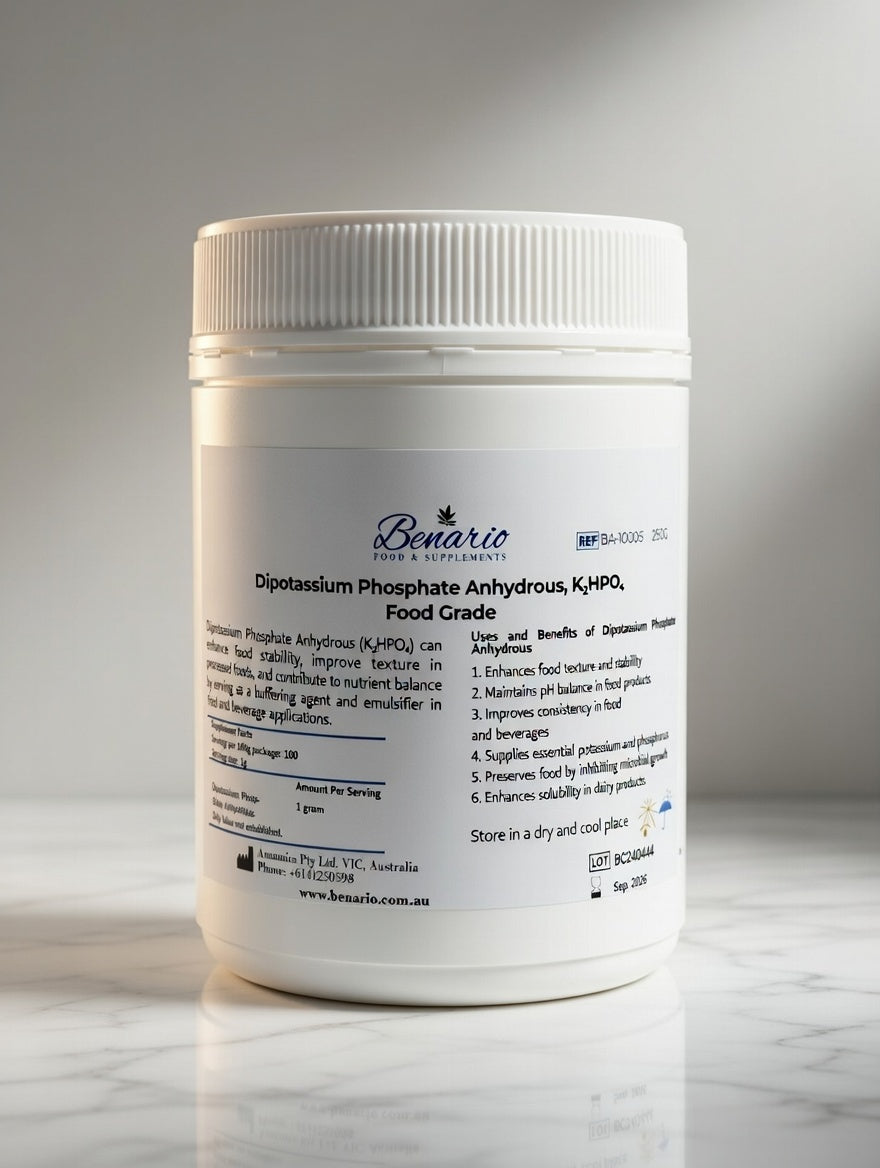
Dipotassium Phosphate (K₂HPO₄) is a versatile FCC grade food additive used as a buffering agent, emulsifier, mineral salt and sequestrant. Approved under FSANZ Standard 1.3.1 (E340ii), it is an essential ingredient in non-dairy creamers, processed cheese, sports drinks, coffee whiteners, fermentation media and food manufacturing applications requiring precise pH control.
- FCC grade (Food Chemicals Codex) — highest food-grade standard for pharmaceutical and food use
- FSANZ Standard 1.3.1 approved (E340ii) — legal for use in Australian food products
- Lab-tested purity ≥98.0% — Certificate of Analysis available on request
- Multifunctional: buffering agent, emulsifier, mineral salt and sequestrant
- Packed in Australia — quality-checked before every dispatch
- Four sizes: 500g, 1kg, 2.5kg and 5kg
- Freely water soluble — easy to incorporate into liquid and dry formulations
| Property | Detail |
|---|---|
| E number | E340(ii) |
| Also known as | DKP, Dipotassium hydrogen phosphate, Potassium phosphate dibasic, E340(ii) |
| Chemical formula | K₂HPO₄ |
| Form | White to off-white crystalline powder or granules |
| Purity | ≥ 98.0% (FCC grade) |
| pH (1% solution) | ~8.8 – 9.2 (alkaline) |
| Solubility | Freely soluble in water |
| Pack sizes | 500g · 1kg · 2.5kg · 5kg |
| Shelf life | 24 months (sealed, cool & dry) |
| Standard | FSANZ E340(ii), FCC, EU E340(ii), GRAS |
Benario is a trading name of AuSaMicS Pty Ltd (ABN 56 676 640 467). This product is intended for use as a food ingredient in accordance with FSANZ Standard 1.3.1. Always use within permitted levels for the relevant food category.
Dipotassium Phosphate is a highly alkaline salt — understanding its pH behaviour is essential for correct use. It is most effective as a buffer, emulsifier and mineral source in applications requiring a neutral to alkaline pH.
| Application | Usage level | Notes |
|---|---|---|
| Non-dairy creamer / coffee whitener | 1 – 3% | Prevents protein precipitation in hot beverages |
| Processed cheese / cheese sauce | 1 – 3% | Emulsifying salt — improves melt and texture |
| Sports / electrolyte drink | 0.1 – 0.5% | Potassium and phosphate source, pH buffer |
| Fermentation / culture media | 0.1 – 0.5% | Standard phosphate buffer for microbial growth |
| Baking / leavening systems | 0.1 – 0.5% | Buffers pH in baking powder formulations |
| Meat processing | 0.1 – 0.5% | Moisture retention, pH adjustment |
| Plant-based milk | 0.1 – 0.3% | Prevents separation, improves stability |
| General pH buffering | As per formulation | Adjust to target pH alongside monopotassium phosphate |
| DKP : MKP ratio | Approximate pH | Application |
|---|---|---|
| 100% DKP only | ~9.0 | Alkaline buffer, culture media |
| 75% DKP : 25% MKP | ~8.0 | Slightly alkaline applications |
| 50% DKP : 50% MKP | ~7.0 | Neutral buffer, sports drinks |
| 25% DKP : 75% MKP | ~6.0 | Slightly acidic applications |
| 100% MKP only | ~4.5 | Acidic buffer |
- Dissolve in warm water (40–60°C) for fastest dissolution
- Add powder to water slowly with stirring — do not add water to powder
- Fully soluble — solutions should be clear to slightly hazy
- Verify pH with calibrated pH meter after dissolution
- Prepared solutions are stable for up to 2 weeks refrigerated in sealed containers
- Store in a cool, dry place away from direct sunlight and moisture
- Keep container tightly sealed — slightly hygroscopic, may cake if exposed to moisture
- Shelf life: 24 months from manufacture date when stored correctly
- Do not store near acids — incompatible with strong acids
Usage levels are indicative. Always comply with FSANZ Standard 1.3.1 permitted levels. AuSaMicS Pty Ltd accepts no responsibility for use outside recommended guidelines.
| Parameter | Specification |
|---|---|
| Chemical name | Dipotassium hydrogen phosphate |
| Chemical formula | K₂HPO₄ |
| CAS number | 7758-11-4 |
| E number | E340(ii) |
| INS number | INS 340(ii) |
| Molecular weight | 174.18 g/mol |
| Appearance | White to off-white crystalline powder or granules |
| Assay (purity) | ≥ 98.0% (K₂HPO₄, FCC grade) |
| pH (1% aqueous solution) | 8.8 – 9.2 |
| Water insoluble matter | ≤ 0.2% |
| Fluoride | ≤ 10 mg/kg |
| Arsenic | ≤ 3 mg/kg |
| Lead | ≤ 2 mg/kg |
| Heavy metals (as Pb) | ≤ 10 mg/kg |
| Applicable standard | FSANZ Standard 1.3.1 (E340ii), FCC 12th Ed., EU E340(ii), JECFA |
| Market | Code / Name | Status |
|---|---|---|
| Australia / NZ (FSANZ) | E340(ii) — Dipotassium phosphate | Approved |
| European Union | E340(ii) — Dipotassium phosphate | Approved |
| United States (FDA) | GRAS — Generally Recognised as Safe | Approved |
| INS (Codex) | INS 340(ii) | Approved |
| FCC Grade | Food Chemicals Codex compliant | Confirmed |
| Size | Price (AUD) | Best for |
|---|---|---|
| 500g | $19.90 | R&D, small production |
| 1kg | $29.90 | Regular commercial use |
| 2.5kg | $59.90 | Frequent commercial use |
| 5kg | $99.90 | Bulk / industrial |
COA available on request — support@ausamics.com
Specifications represent typical values per FCC 12th Edition. Batch-specific results confirmed in COA.
Dipotassium Phosphate is approved under FSANZ Standard 1.3.1 (E340ii) and classified as GRAS in the USA. It is an alkaline salt — handle with standard food-grade precautions.
- Approved food additive — FSANZ E340(ii), EU E340(ii), GRAS (USA)
- No known common allergens — gluten-free, vegan and vegetarian suitable
- Alkaline pH in solution (~9) — avoid contact with eyes; rinse immediately if contact occurs
- Contains potassium and phosphate — people on potassium-restricted diets should consult a healthcare professional
- Incompatible with strong acids — do not mix with concentrated acids
- Keep dry powder away from moisture and heat sources
| Route | Action |
|---|---|
| Skin contact | Wash thoroughly with soap and water. Remove contaminated clothing. |
| Eye contact | Rinse immediately with clean water for 15–20 minutes. Seek medical advice. |
| Ingestion | Rinse mouth with water. Seek medical advice if large quantities ingested. |
| Inhalation | Move to fresh air. Seek medical advice if symptoms persist. |
| Hazard category | Classification |
|---|---|
| Physical hazards | Not classified |
| Health hazards | Eye irritation (Category 2) — alkaline pH in solution |
| Environmental hazards | Not classified |
| Signal word | Warning |
| Precautionary | Wear eye protection when handling solutions; wash hands after use |
Full SDS available on request — support@ausamics.com
This is a general safety summary only. For commercial use, request the full SDS. AuSaMicS Pty Ltd (ABN 56 676 640 467) accepts no liability for misuse of this product.
Have a question not answered here? Contact us at support@ausamics.com — we typically respond within 1 business day.
Share